The Genesis of the Wolfdog: A Visionary’s Quest
The Saarloos Wolfdog is not merely a dog that looks like a wolf; its very existence is a testament to one man’s decades-long pursuit of restoring the “natural” qualities he believed had been lost in domesticated breeds. This captivating and highly specialized breed owes its foundation entirely to Leendert Saarloos (1884–1969), a Dutch enthusiast who passionately believed that the German Shepherd Dog had become too “humanized” and overly reliant on its handler. His goal was not to create a working dog—though he initially sought to produce a better service dog—but rather to breed a dog with the resilience, health, and inherent wariness of its wild ancestors.
In 1935, Saarloos began his ambitious project by crossing a male German Shepherd Dog with Fleur, a female European Wolf. The initial progeny were then backcrossed to the German Shepherd, meticulously guided by a vision to create a dog that retained the wolf’s structure and independent spirit while possessing the loyalty and devotion of a canine companion.
The result of this careful, selective breeding over several decades was the Saarloos Wolfdog, a breed officially recognized by the Fédération Cynologique Internationale (FCI) in 1975. This recognition cemented its status as a distinct breed, separate from both the German Shepherd and the wolf, yet defined by the characteristics of both. Understanding this foundational history is crucial for any potential owner, as the wolf’s DNA is not just cosmetic; it dictates the dog’s unique and often challenging temperament.
Physical Majesty: A Portrait of Wolfish Elegance
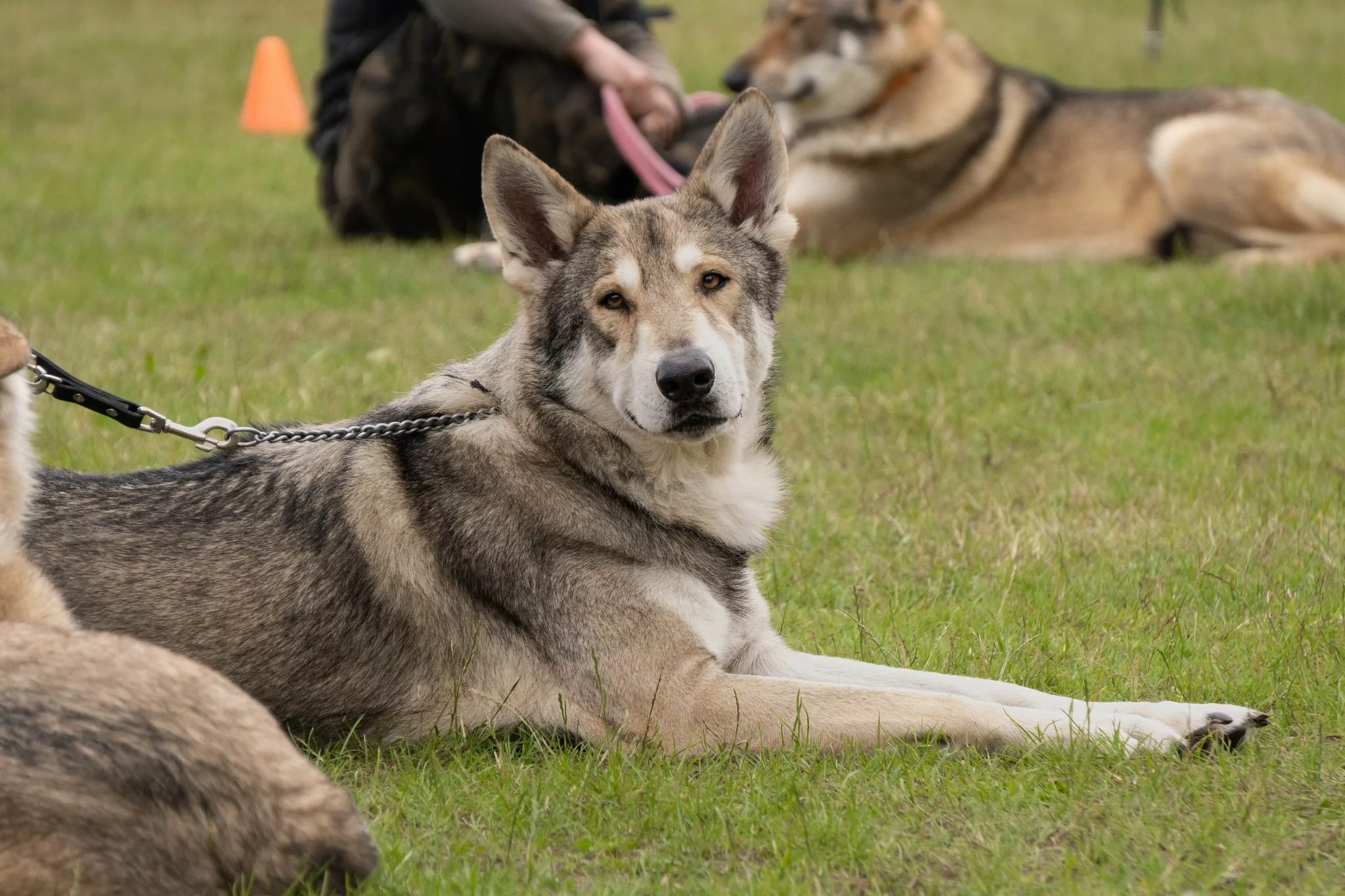
The most immediate and striking feature of the Saarloos Wolfdog is its unmistakable wolf-like appearance, a quality that is both its blessing and its challenge in the modern world. It is a powerful, athletic, and elegantly proportioned dog, built for tireless trotting and covering vast distances with minimal effort.
The Signature Look
- Size and Build: They are large dogs, with males standing between $65$ and $75$ cm (25.5 to 29.5 inches) at the shoulder and weighing between $36$ and $41$ kg (79 to 90 pounds). The body is long rather than short, displaying the harmonious balance of a wolf rather than the steep angulation sometimes seen in modern German Shepherds.
- Coat and Color: The breed possesses a thick, dense double coat—a harsh outer layer protecting a soft, dense undercoat that is shed heavily twice a year. The preferred color is “wolf grey,” ranging from a light grey-beige to a darker, shadowy grey. Other accepted colors include “wolf brown” (a light-to-dark shaded brown) and white. Crucially, all wolf grey and wolf brown dogs exhibit a pale, creamy white or white mask and light markings on the undersides.
- Distinctive Features: The dog’s expression is perhaps its most telling feature. The yellow, almond-shaped eyes are set slightly obliquely, lending the dog its characteristic reserved, alert, and often piercing gaze. The ears are medium-sized, firm, triangular, and highly mobile, constantly communicating the dog’s mood. The tail is set low, bushy, and typically carried in a slight saber shape, rarely curled high over the back.
Temperament and Trainability: The Independent Spirit
The true nature of the Saarloos Wolfdog is where the wolf ancestry manifests most profoundly, resulting in a temperament that demands an experienced, patient, and consistent owner. This is not a breed for the faint of heart or the novice dog owner.
The Reserved and Independent Nature
The most defining characteristic of the Saarloos is its innate reserve and extreme caution around unfamiliar people and novel situations. They are loyal and deeply devoted to their immediate family or “pack,” forming extremely tight bonds. However, their instinct when facing the unknown is to retreat and observe, mirroring the survival tactics of a wild wolf.
- Avoidance, not Aggression: When confronted by strangers, a typical Saarloos will not engage aggressively but will instead exhibit classic avoidance behavior, often attempting to flee or hide. This innate timidity means they are generally poor guard dogs—a fact that disappointed Leendert Saarloos in his initial goal—but they can be excellent watchdogs for their immediate territory.
- The Pack Need: The Saarloos Wolfdog thrives on social interaction and suffers significantly from separation anxiety if left alone for extended periods. They need to be fully integrated into the family’s daily life, preferring constant presence, either human or canine.
Training and Socialization Imperatives
Training a Saarloos Wolfdog requires a different approach than training a typical German Shepherd. They are intelligent but possess a fierce independence, prioritizing their own will over instant obedience.
- Early and Extensive Socialization: This is non-negotiable. Due to their innate wariness, a Saarloos puppy must be exposed early and often to a wide variety of sights, sounds, people, and environments. This socialization must be controlled, positive, and gentle, focusing on building confidence rather than forcing interaction.
- Positive Reinforcement: The breed responds poorly to harsh corrections or dominance tactics. They require patient, positive reinforcement training built on mutual respect and trust. They are selectively obedient, meaning they must understand the why behind a command and must feel respected by their handler.
- High Prey Drive: Due to their wolf ancestry, they possess a strong, natural prey drive. They should never be trusted alone with small pets (cats, rabbits, small rodents) unless they have been raised with them from an early, controlled age. Secure fencing is paramount, as their curiosity, independence, and athleticism make them notorious escape artists.
Health and Care: Longevity and Genetic Considerations
The Saarloos Wolfdog is generally considered a robust and relatively healthy breed, a positive trait Leendert Saarloos successfully bred back into the line. Their average lifespan is typically 10 to 12 years, with some individuals living even longer.
Key Health Concerns
However, like all large breeds, they are predisposed to certain genetic issues, many of which trace back to the German Shepherd foundation stock:
- Hip and Elbow Dysplasia (HD/ED): These conditions involve the abnormal formation of the hip and elbow joints and are a major concern for all large, fast-growing breeds. Reputable breeders require mandatory health testing (X-rays) for both parents before breeding.
- Pituitary Dwarfism (Dw): This rare, severe hereditary condition affects growth hormones, leading to stunted growth, coat problems, and a significantly shortened lifespan (rarely surviving past five years). Genetic testing for this recessive disorder is crucial and mandatory for responsible breeding.
- Degenerative Myelopathy (DM): A progressive disease of the spinal cord that affects the hind legs, typically appearing later in life (around 8-9 years old). Genetic testing allows breeders to avoid producing “Affected” puppies by only breeding “Free” dogs or “Free” dogs with “Carrier” dogs.
Grooming and Exercise Needs
The Tundra’s coat requires moderate but consistent care. Weekly brushing is essential to manage the shedding, which becomes profuse during the twice-yearly “blowing” of the coat.
Their exercise needs are high. The Saarloos Wolfdog is an untiring trotter, requiring a minimum of 60 to 70 minutes of robust physical activity daily. This goes beyond a casual walk; they need opportunities to run, explore, and engage in mental stimulation. They thrive in secure, large outdoor spaces and are excellent partners for dedicated hikers and runners, provided they have a strong bond and reliable recall training.
A Comparison: Saarloos Wolfdog vs. Czechoslovakian Wolfdog
It is impossible to discuss the Saarloos Wolfdog without mentioning its close relative, the Czechoslovakian Wolfdog (or Vlčák), a breed created for military work by crossing the German Shepherd with the Carpathian Wolf around the same period. While they look superficially similar, their temperaments are the key differentiator:
| Feature | Saarloos Wolfdog | Czechoslovakian Wolfdog (CSW) |
| Founding Goal | To restore natural caution and resilience (Companion) | To create a highly functional military/border patrol dog |
| Primary Temperament | Reserved, Cautious, Timid, Avoidance-driven | Brave, Energetic, Bolder, More assertive |
| Trainability | Selectively obedient; needs high trust; less food motivated | Easier to train; more food/praise motivated; higher working drive |
| Socialization Needs | Extreme; highly sensitive to noise and new environments | High; easier to integrate into busy/urban environments |
| Activity Level | High endurance trotter; also enjoys being a “couch potato” | Extremely high energy; needs constant, intense physical output |
The Final Verdict: Is the Saarloos Wolfdog the Right Companion?
The Saarloos Wolfdog is a breed of majestic beauty and profound sensitivity. It is a commitment—a living piece of natural history—that will challenge the very definition of the human-canine bond.
They are ideal for:
- Experienced dog owners who understand primitive breeds.
- Active households that can integrate the dog fully into daily life and rarely leave it alone.
- Owners with secure, double-fenced property who enjoy extensive outdoor activities like hiking and running.
They are not suitable for:
- First-time dog owners.
- Individuals living in apartments or small urban spaces.
- Homes with a high traffic of strangers or a lack of time for extensive daily exercise and socialization.
Owning a Saarloos Wolfdog is a journey of patient understanding and mutual respect. The reward is a profound, loyal bond with a magnificent animal that is, perhaps, the noblest ghost of the wild world living within our homes.
About the Author